
The PIE Method
Perceive · Integrate · Embody
The PIE Method is a phase-based therapeutic framework for clinical and training contexts.
PIE is designed for practitioners who support clients with strong self-awareness and still encounter moments where understanding alone does not lead to lived change. This is the phase in which insight is present, but internal organization has not yet shifted.
PIE names and structures what comes next by clarifying the conditions required for perception to stabilize, integration to occur, and change to become embodied.

A Common Post-Insight Mismatch
In therapeutic work, a recurring mismatch often emerges after insight has been established.
Clients may appear outwardly functional and psychologically intact, yet internally their regulation remains effortful. Reactions continue to initiate automatically, even when alternative responses are clearly understood. Physiological activation often persists long after precipitating events have passed.
Clients can accurately narrate patterns understood to underlie their difficulty; however, this recognition typically occurs only after emotional and behavioral responses have already organized.
This presentation commonly includes:

Assuming responsibility reflexively, even when rest or restraint is intended
Noticing tension only after it has already shaped behavior
Recognizing a familiar pattern mid-response, without the capacity to interrupt it
Maintaining internal standards that are no longer consciously endorsed
Actively managing internal states rather than inhabiting experience
This reflects a stable internal organization that awareness alone does not reliably reorganize.
At this stage, clients may understand the problem clearly yet lack a way to translate that understanding into real-time change. Insight is present, but the system has not reorganized around it.
PIE addresses this specific phase of work by clarifying the conditions required for perception to stabilize, integration to occur, and responses to become embodied rather than managed.
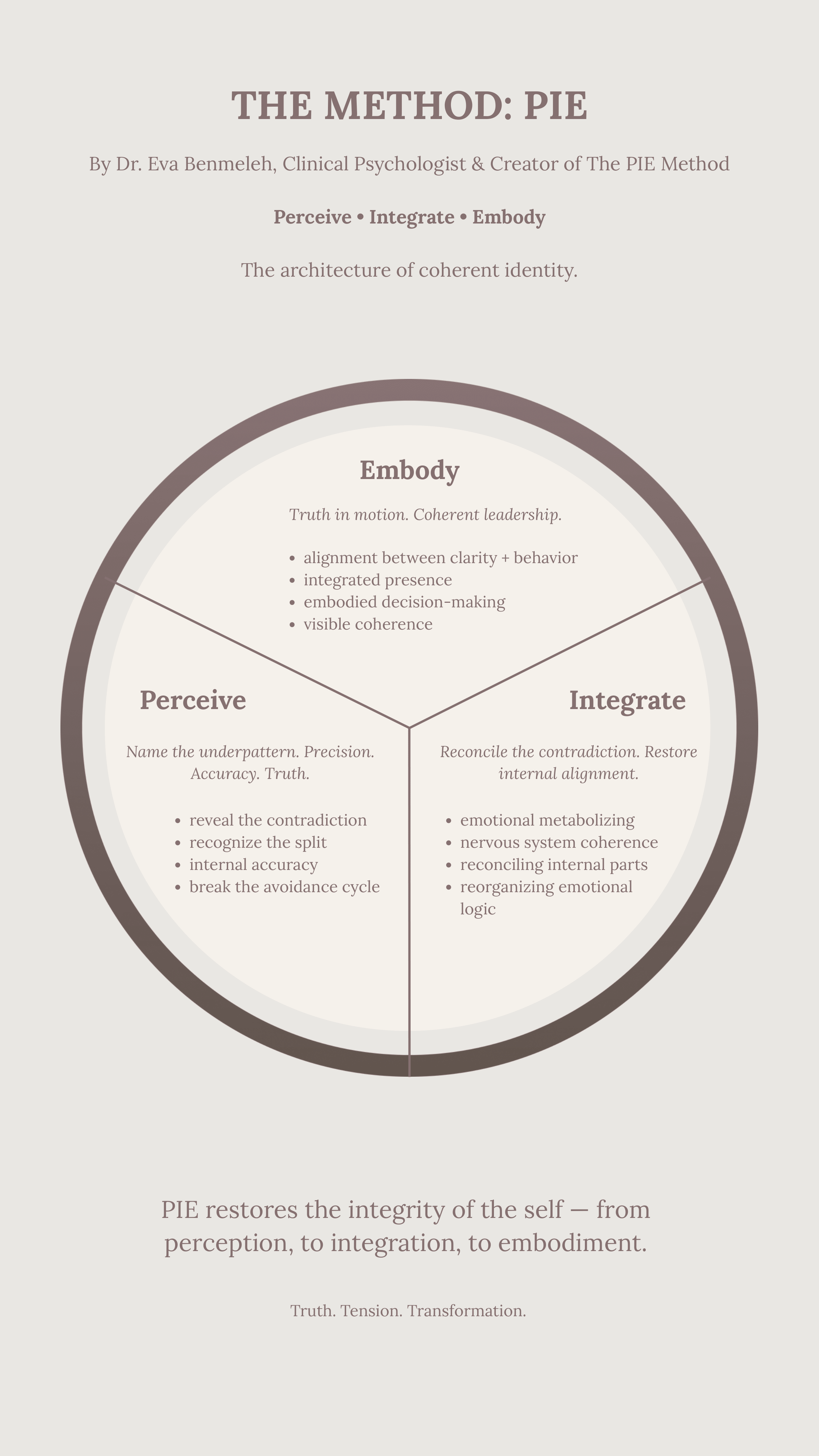
THE METHOD: PIE
PIE is a disciplined framework composed of three interrelated phases. It describes how internal organization within the psyche either stabilizes or does not, once insight is present. PIE clarifies the conditions under which perception, integration, and embodiment reorganize experience coherently.
Perceive: Notice what is actually present.
Perception, in this framework, refers to the capacity to register experience accurately, including information that has been bypassed, justified, minimized, or over-intellectualized. This phase is not oriented toward change, correction, or resolution. Its function is to stabilize awareness so experience can be registered without forcing an outcome.
Perception establishes the ground upon which all further reorganization depends.
Integrate:
Integrate refers to the organization of previously understood material into a coherent internal structure. At this phase, insight becomes structurally meaningful rather than solely cognitive, allowing internal contradictions to resolve through coherence rather than effort.
What the pattern has protected
Why it persisted
What conditions originally made it necessary
As this logic becomes coherent, resistance often softens its grip not through confrontation, but through loss of necessity.
Embody:
Embody refers to the stabilization of internal organization such that response, decision-making, and relational movement no longer require active management. Regulation becomes implicit, and behavior reflects internal coherence rather than strategy.
WORK USING THE PIE METHOD
The PIE Method is the foundational framework informing the professional services and educational offerings of Dr. Eva Benmeleh.
Professional services utilizing the PIE Method may be offered through training, workshops, and related educational formats designed for practitioners.
Authority
The PIE Method was developed by Eva Benmeleh, PhD, as a distinct therapeutic framework synthesizing psychological depth with process-oriented, embodied organization.